
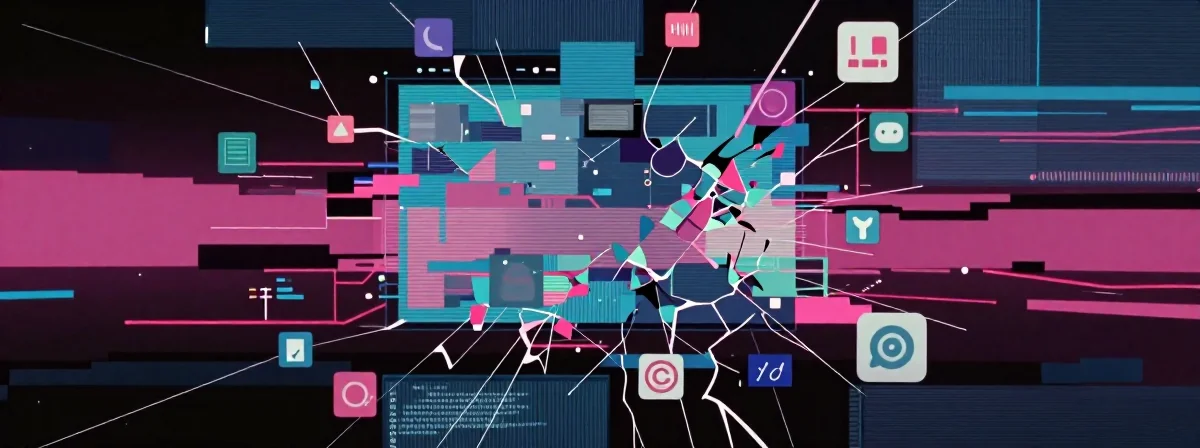
Ever seen your iPhone screen glitch so badly it looks like a GPU artifact? The jumbled pixels, the distorted icons, the pink glare from the clock—these symptoms scream “hardware failure.” But what if the culprit isn’t what you assume? The pattern here is deceptive, and the data shows something far more nuanced.
At first glance, this looks like a classic GPU meltdown—the kind you’d expect on a gaming PC, not a smartphone. But the inconsistencies in the artifacts—how they appear behind icons, how some icons load properly while others glitch—point to a different system at play. The anomaly suggests this isn’t purely hardware. What the data shows is a clash between software rendering and display processing, not a dying GPU.
Tech experts have observed similar behavior in iOS systems where rendering pipelines get corrupted. It’s like a traffic jam in your phone’s operating system, not a broken engine.
Why Does It Look Like GPU Artifacts?
The human brain is wired to recognize patterns, and when we see jumbled pixels, we default to “GPU failure.” But the key difference here is the artifacts’ behavior. On a PC, GPU artifacts would affect the entire screen uniformly—no exceptions. On this iPhone, however, some elements render correctly while others don’t. The icons that glitch are inconsistent, and even the wallpaper appears distorted in patches. This isn’t random hardware noise; it’s selective corruption.
Think of it like a corrupted file system. If the GPU were failing, the entire display pipeline would crash—not just parts of it. The fact that you can screenshot the artifacts is another red flag. A true GPU failure would manifest in ways that can’t be captured by software (like a physically broken screen). Since the artifacts are reproducible in screenshots, this points to a software-level rendering issue.
The Role of iOS Updates and Rendering Bugs
What the data shows is that these glitches often correlate with recent iOS updates or beta testing. In one case, a user reported identical symptoms after installing iOS 26.2 beta. After a patch, the issue resolved itself. This isn’t a coincidence. iOS updates sometimes introduce rendering bugs that affect how the GPU and display communicate. It’s like two systems speaking different languages—causing visual chaos.
The clock’s pink glare, for example, could be a leftover color buffer from a failed rendering cycle. The icons that don’t load properly might be due to corrupted texture data in memory. These aren’t GPU artifacts; they’re artifacts of a broken software state.
Why Factory Reset Might—or Might Not—Help
If this is a software issue, a factory reset could clear corrupted files and reset rendering pipelines. But if the problem stems from a deeper system bug (like a lingering memory leak or a misconfigured driver), even a DFU reset might not fix it. The inconsistency here is that some users report success with resets, while others see the glitch return. This suggests the root cause isn’t always in the software.
Backup everything first—this is non-negotiable. If the issue is hardware-related (which we’re still skeptical about), you need to extract your data before the phone becomes unusable. But if it’s software, you might regain functionality after a reset. The gamble is whether the corruption is in volatile memory or baked into the system.
The Matrix Metaphor—and Why It’s Funny
Some users joked, “Your phone has entered the matrix.” It’s a fitting metaphor. When your iPhone glitches like this, it’s like peeling back the layers of the operating system to see the raw code underneath. The artifacts aren’t random—they’re glimpses of the rendering engine’s failures. It’s a digital equivalent of seeing the “green code” from The Matrix.
But don’t let the humor fool you. This isn’t just a quirky bug. It’s a system failing in predictable ways, and understanding those patterns is how you diagnose it.
When to Accept Defeat and Upgrade
If you’ve backed up your data, tried resets, and the glitch persists, the reality is this: some hardware might be at play. While we’ve argued against a pure GPU failure, components like the display controller or RAM could be degrading. The stuttering, the inconsistent artifacts—these could be signs of a failing system that no software fix can salvage.
At this point, the best move is to replace the phone. The cost of repairs (if even possible) outweighs the value of the device. Consider it a lesson in system diagnostics: when software and hardware symptoms overlap, always rule out the simplest explanations first.
The Hidden Pattern That Makes It All Click
What ties all these observations together is the principle of layered systems. Your iPhone isn’t one monolithic device—it’s a stack of software, drivers, and hardware. When something goes wrong, the symptoms reveal which layer is failing. In this case, the selective nature of the artifacts points to software rendering, not GPU death.
The next time you see a glitch like this, don’t jump to conclusions. Analyze the behavior: Is it consistent? Can it be captured in screenshots? Does it correlate with software changes? The answers will guide you toward the real problem. And remember—sometimes the “glitch” is just the system showing you its true, imperfect self.