
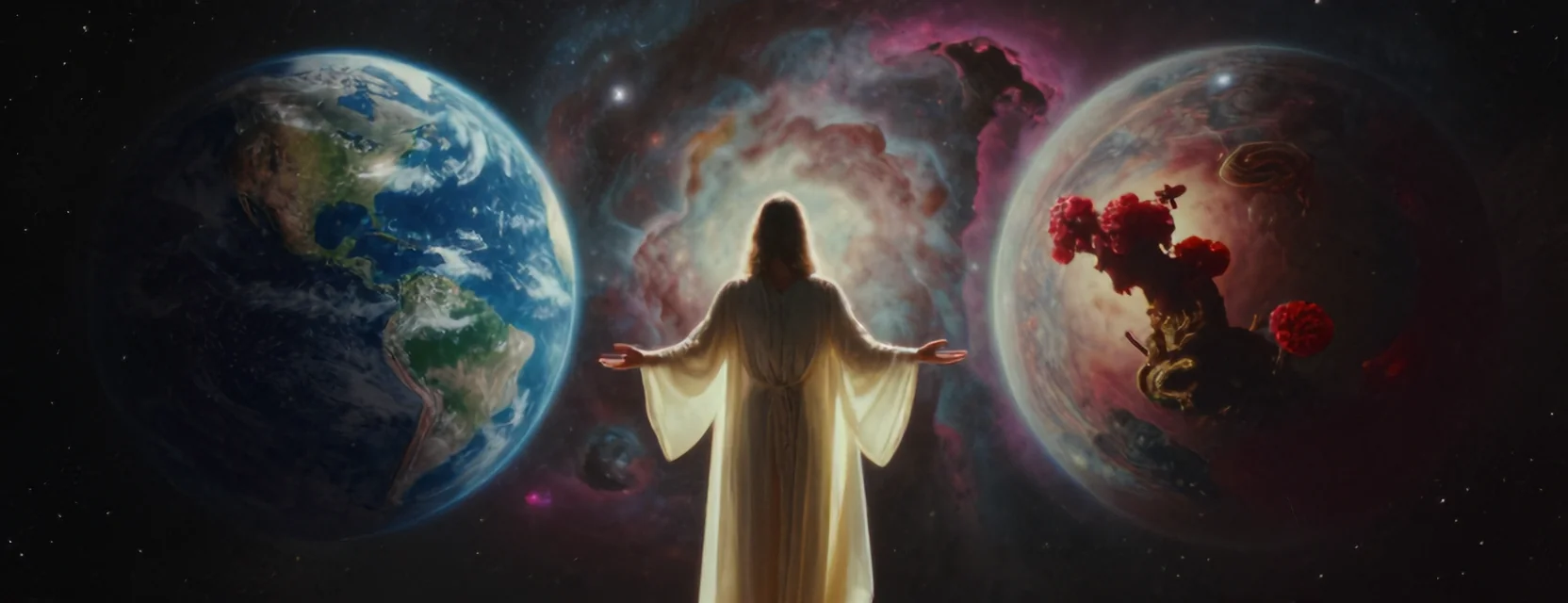
You’ve seen the headlines: “Discovery of Alien Life Could Upend Religion.” The narrative is always the same—scientists find microbes on Europa, and suddenly theologians are scrambling to rewrite scripture. It’s a story we tell ourselves to feel superior, as if we’ve caught the faithful in a cosmic bluff. But what if the real surprise isn’t that some believers would struggle, but that so many would barely blink? What if the God they worship is already bigger than our solar system?
The panic over extraterrestrial life reveals more about our limited imagination than about religious rigidity. We’ve been taught to think of faith as a fragile house of cards that collapses when faced with the unfamiliar. But for centuries, theologians have been contemplating worlds beyond our own—not as threats to doctrine, but as extensions of God’s creativity. The real tension isn’t between faith and aliens; it’s between our provincial understanding of both.
It turns out, the God who spoke galaxies into existence might not be as surprised by intelligent life on Kepler-452b as we are.
The Teaching
C.S. Lewis Knew This Before Rocket Ships Did
The great Christian apologist wasn’t just writing science fiction when he imagined Perelandra and Malacandra. In his essay “Religion and Rocketry,” Lewis argued that finding intelligent life wouldn’t shatter Christian theology—it would merely raise new questions about the Incarnation. His real fear wasn’t alien invasion, but human contamination. “If men ever reach other planets,” he wrote, “they will carry thither, not religion, but vice.” The irony is that the man who imagined talking lions and interstellar journeys was more prepared for aliens than most of us.The Incarnation Isn’t Geographically Exclusive
When Christians say “God became human,” they’re not issuing a species-specific warranty. The doctrine of the Incarnation addresses humanity’s particular brokenness, but it doesn’t require Jesus to have a passport. As one theologian put it, “The Word became flesh here, but that doesn’t mean the Word couldn’t become something else somewhere else.” The God who formed Adam from earth might just as easily have formed something else from different earth. Our problem isn’t cosmic loneliness; it’s cosmic provincialism.
- Original Sin Isn’t a Real Estate Deal
Here’s where it gets interesting: many Christian traditions don’t believe sin automatically transfers to other intelligent beings. If aliens exist and haven’t “fallen,” they might not need redemption in the same way humans do. Dutch Reformed theologian Abraham Kuyper once noted that “sin entered the world through one man,” implying a species-specific brokenness. This isn’t a gotcha moment—it’s an invitation to see sin not as universal, but as a particular human problem within God’s larger creation. The good news isn’t that we’re all sinners; it’s that God became one of us to fix that.
The Vatican Has an Alien Protocol (Seriously)
Forget the conspiracy theories—the Vatican actually employs astronomers and has for centuries. When the James Webb Space Telescope first revealed distant galaxies, it wasn’t theologians who were most surprised; it was astronomers realizing how little they knew. The Vatican’s position is simple: if we meet aliens, first determine if they’ve fallen. If not, no conversion needed. If they have, then yes—missionary work begins. It’s theologically elegant and practically sensible. The real question isn’t whether God would send missionaries; it’s whether we would recognize them if they came in a spaceship instead of a stable.“Made in God’s Image” Isn’t a Fashion Statement
When Genesis says humans are created “in God’s image,” it’s not describing a physical resemblance. It’s talking about capacity—for relationship, for morality, for knowing God. The medieval theologian Thomas Aquinas argued that the “image of God” refers to the rational soul, not the body. So when a believer says aliens could be “made in God’s image,” they’re not suggesting extraterrestrials wear beards and robes. They’re saying God’s creative power isn’t limited by our carbon-based assumptions. The body is a shell; the soul is the signature.The Fermi Paradox Isn’t a Theological Crisis
If the universe is so big, why haven’t we met anyone? This “Fermi Paradox” gets framed as evidence against God, but it could just as easily be evidence of God’s restraint. Maybe God deliberately limits contact until we’re ready. Maybe other beings exist beyond our detection. Maybe the silence isn’t absence, but waiting. The great medieval theologian Anselm described God as “that than which nothing greater can be conceived”—a definition that doesn’t shrink when the universe expands. Our problem isn’t that God is too small; it’s that we’re too easily impressed by our own galaxy.The First Bishop of Mars Will Be Bored
Here’s a fun historical fact: under Catholic canon law, the bishop of the diocese from which an expedition launches gains jurisdiction over any new territory. That means the bishop of Orlando is technically the bishop of the moon. If humans colonize Mars, the first Martian bishop won’t be fighting demons; he’ll be dealing with zoning disputes and Sunday attendance numbers. The cosmic joke is that the most dramatic encounter with extraterrestrial life might just produce the most mundane administrative paperwork in church history.
The Practice
We’ve been asking the wrong questions about religion and aliens. The real tension isn’t between faith and discovery, but between our limited imagination and God’s boundless creativity. When we finally meet beings from another world—if we ever do—they might not challenge our theology; they might complete it. The universe is so vast precisely because God meant for it to be filled—not with our projections, but with God’s surprises. And perhaps the greatest surprise of all is that the God who made it all might just be waiting for us to notice.