
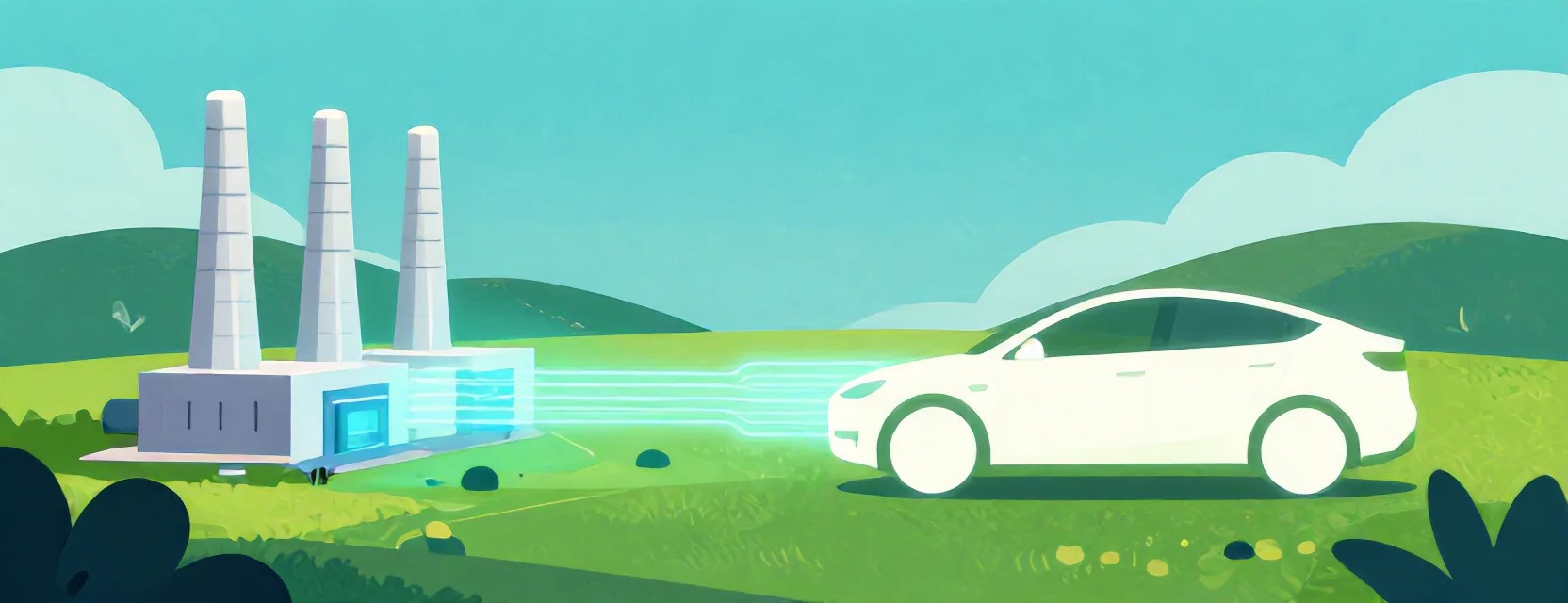
You’ve probably heard the argument: “EVs aren’t really green because they’re often charged with fossil fuels.” It sounds logical, right? But here’s the thing – even when your electric car is charged from the same coal plant as your neighbor’s gas guzzler, it’s still cleaning up. The secret lies not in the coal itself, but in where that energy is created. Most people focus on the tailpipe (or lack thereof), but the real magic happens miles away at the power plant.
The conventional wisdom about EVs versus internal combustion engines (ICEs) is missing a crucial piece of the puzzle. We compare apples to oranges when we just look at the final vehicle. The truth is deeper, more counterintuitive, and frankly, a bit embarrassing for gas cars. Your electric car isn’t just about the battery – it’s about the entire energy ecosystem that supports it, and that ecosystem has some tricks up its sleeve that your gas tank could never dream of.
What if I told you that the most efficient part of your electric car isn’t in the car at all? The real efficiency revolution happens at the power plant, where engineers have been perfecting energy generation for decades while car manufacturers have been struggling to make engines that can handle everything from idling at stoplights to flooring it on the highway.
Why Your Power Plant is Smarter Than Your Car’s Engine
Imagine trying to design a machine that needs to operate efficiently at 600 RPM and 6000 RPM simultaneously. That’s essentially what car manufacturers face when building an internal combustion engine. Your Honda Accord might cruise comfortably at 2000 RPM, but that same engine needs to be ready to rev up to 7000 RPM when you stomp on the gas – and it needs to do all this without “grenading itself,” as one automotive enthusiast put it. The result? A whole lot of compromises that make engines inherently inefficient.
Now picture a power plant. It doesn’t need to be portable, it doesn’t need to handle sudden acceleration, and it doesn’t need to be lightweight. It can be built to do one thing exceptionally well: generate electricity. These central power generation facilities can incorporate advanced technologies like reclamation systems and extensive emissions scrubbing that would be impractical (or impossible) in a vehicle. Even when powered by fossil fuels, these plants are typically 30-50% more efficient at converting fuel to energy than your car’s engine.
Think of it like this: Your car’s engine is like a jack-of-all-trades who’s mediocre at everything, while the power plant is like a world-class specialist who only does one thing but does it better than anyone else. The power plant can afford to be bulky and complex because it’s stationary – it can build massive machinery that would be laughably impractical to roll down the highway. This is why we centralize power generation in the first place, and it’s why EVs win the efficiency battle even when they’re plugged into the same grid as your neighbor’s gas station.
The Battery: Not Just a Battery, But a Magic Energy Hub
Here’s where it gets really interesting. Even if we could magically make car engines as efficient as power plants (which we can’t, due to physics and engineering constraints), we’d still have a problem: how do you get that efficient energy from the power plant to the wheels? That’s where the battery comes in, and it’s not just a storage device – it’s a smart energy intermediary that makes the whole system work.
When you plug in your EV, you’re not just charging a battery. You’re participating in an energy optimization system. Power plants generate electricity at their peak efficiency, shunt that power into your battery, and then your electric motor converts that stored energy into motion with minimal loss. It’s like having a personal energy consultant in your trunk who knows exactly how to get the most out of every electron.
The beauty of this system is that it works even with our current grid. As one energy expert pointed out, “it’s presumably a lot easier to decarbonize the grid than the cars – it’s already happening incrementally in a lot of places with solar and wind replacing fossil fuels as the grid grows.” Your EV becomes an increasingly clean vehicle not because of any magic in the car itself, but because it’s connected to a grid that’s gradually getting cleaner. It’s like joining a fitness program that gets more effective over time – you’re benefiting from continuous improvement without having to upgrade your membership.
Regenerative Braking: The Hidden Efficiency Weapon
While we’re on the topic of efficiency, let’s talk about something gas cars can only dream of: regenerative braking. This isn’t just a cool feature – it’s a fundamental advantage that EVs have over their ICE counterparts. Every time you hit the brakes in an electric car, a portion of that kinetic energy is captured and stored in your battery instead of being wasted as heat.
Think about how often you brake during a typical drive. In city driving, you’re braking constantly. All that energy that would otherwise be completely lost is instead being recycled. It’s like having a personal energy recycler in your car who picks up every dropped electron and puts it back to work. Over the lifetime of your EV, this feature alone can save thousands of dollars in energy costs and reduce your carbon footprint significantly.
The math is pretty staggering. Even if your EV is charged from a coal plant, studies have shown that it still cuts carbon emissions by about two-thirds compared to an equivalent ICE vehicle. That’s right – even with coal, EVs win. And as the grid gets cleaner, your EV gets cleaner automatically. It’s like buying a self-upgrading car – you don’t have to do anything, it just gets better over time.
The Future Is Vehicle-to-Grid: Your Car as a Power Plant
We’re just scratching the surface of what’s possible with EVs. The next frontier is vehicle-to-grid (V2G) technology, where your car doesn’t just consume energy from the grid – it can also feed energy back into it. Imagine your EV as a mobile battery that helps balance the grid during peak demand periods. During off-peak hours, your car charges; during peak hours, it can discharge some of that energy back to the grid, earning you money while helping stabilize the system.
This concept isn’t as far-fetched as it sounds. Modern EVs already carry incredible energy capacity – a Tesla Model 3 has about 75kWh, while some pickups like the Ford Lightning carry over 130kWh. That’s enough to power an average home for several days. As one tech enthusiast noted, “If they can be used to give energy to the grid or take out excess energy it would help balance the grid immensely.”
The implementation challenges are real – we need to address user concerns about their car’s charge level and ensure the system is intuitive and reliable. But the potential benefits are enormous. A fleet of EVs could essentially function as a distributed energy storage system, making renewable energy more viable and reducing the need for expensive new power plants. It’s like turning every EV owner into a mini power company, without them even realizing it.
The Physics of Efficiency: Why Gas Cars Will Never Catch Up
Let’s get down to the nitty-gritty of why gas cars are fundamentally limited in their efficiency. Car engines operate across an incredibly wide range of conditions – from idle to full throttle, from cold starts to highway cruising. Each of these conditions requires different optimal settings, and engineers have to compromise to make the engine work acceptably across all of them.
Worse yet, car engines waste a tremendous amount of energy as heat. As one physics expert explained, “The waste heat is at too low a temperature to extract heat from it with any usable efficiency. There’s no way around this. You cannot concentrate it either.” This is why you can’t just slap a turbocharger or some other heat recovery system on a car engine and magically boost its efficiency – the laws of thermodynamics have the final say.
EVs, on the other hand, use electric motors that are inherently more efficient. They don’t have the same range of operating conditions, and they don’t waste energy as heat in the same way. Even accounting for transmission losses and battery charging inefficiencies, the overall system is still more efficient than the ICE alternative. It’s like comparing a well-oiled machine to a constantly struggling one – the difference isn’t just in the parts, it’s in how they work together.
The Grid Transition: Why EVs Are the Perfect Bridge Technology
One of the most misunderstood aspects of the EV revolution is its relationship with the power grid. Critics often point out that many grids still rely on fossil fuels, implying that EVs aren’t truly clean. What they miss is that EVs are actually accelerating the transition to cleaner energy.
As we mentioned earlier, it’s easier to decarbonize the grid than individual vehicles. Power plants can incorporate advanced emissions controls and reclamation technologies that would be impractical in vehicles. And because EVs are more efficient, they require less energy to do the same work as gas cars. This creates a virtuous cycle: as more people adopt EVs, utilities have stronger incentives to clean up their grids, and as grids get cleaner, EVs get cleaner automatically.
The transition isn’t happening overnight, of course. We still need solutions for grid storage and peak demand management – solutions that EVs themselves can help provide through V2G technology. But the direction is clear: EVs aren’t just a transportation solution; they’re a key part of our broader energy transition. They’re like the perfect bridge technology that helps us move from our current energy system to a cleaner future.
The Final Efficiency Equation: It’s Not Just About the Car
When we talk about EV efficiency, we often focus too narrowly on the vehicle itself. But the real story is much bigger – it’s about the entire energy ecosystem, from power plants to transmission lines to the vehicles that use that energy. And when you look at the whole picture, EVs come out ahead every time, even with our current energy infrastructure.
The next time someone tells you that EVs aren’t really green because they’re charged from fossil fuels, you can smile knowingly. You understand the secret that makes EVs more efficient than their critics realize. It’s not just about the lack of tailpipe emissions – it’s about the entire system that supports electric vehicles, from the power plants that generate cleaner energy more efficiently to the batteries that store and deliver that energy with minimal loss.
And as the grid continues to evolve, your EV gets better automatically. It’s like buying a car that improves itself over time without you having to lift a finger. Now that’s efficiency.