
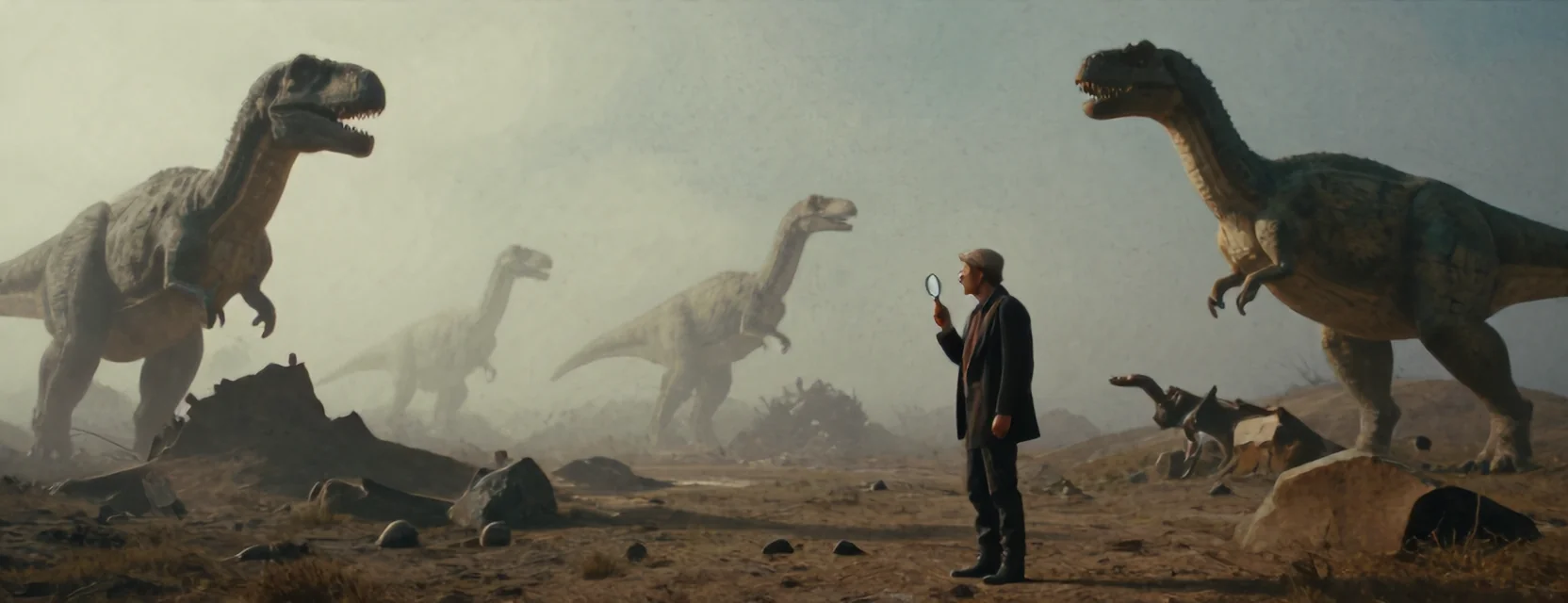
Dinosaurs. We’ve all seen them in movies, read about them in books, maybe even had a few plastic models in our childhood bedrooms. We feel like we know what they looked like – the T-Rex with its mighty jaws, the Triceratops with its distinctive horns. But here’s the thing: a lot of those famous images? We actually got them wrong, sometimes completely. How can scientists be sure about what these giant creatures looked like when all they have are scattered, ancient bones? It turns out, it’s less like having a complete blueprint and more like being a detective with only a few clues.
We all picture those iconic dinosaur shapes, right? Those images are deeply ingrained in our culture, thanks partly to movies like Jurassic Park. But imagine finding out that the dinosaur you thought you knew, the one you saw roar on the big screen, might have looked totally different in real life. It’s not just a minor detail; sometimes it’s a complete reshuffle. The way scientists figure out dinosaur appearance is a fascinating, ongoing process, full of educated guesses and constant revisions. It’s less about certainty and more about piecing together a puzzle with missing pieces, using every scrap of evidence they can find.
The truth is, scientists piece together dinosaur appearances by connecting the dots, starting with the bones they find and then making their best guesses based on what they know from other, better-preserved dinosaurs. It’s a bit like trying to draw a whole person when you only have a hand and a foot – you have to make some educated assumptions about what connects them and what the rest might look like, using what you know about humans in general. This method means our understanding changes as new fossils are discovered, sometimes dramatically.
How Much Do We Really Know From Just Bones?
Okay, so you find a fossil. Maybe it’s a leg bone, maybe it’s part of a skull. Can scientists instantly know what dinosaur it is and what it looked like? Not exactly. If it’s just a few random fragments, they often can’t know for sure based on those alone. They look at the shape – the dentition (that’s just a fancy word for teeth, by the way!), the curve of a bone, the way joints might have fit together – and make a very educated guess about what kind of dinosaur it might be and what part of the body it came from. Think of it like identifying a piece of modern machinery; even if you don’t know the whole machine, you can often tell what function a specific gear or lever serves based on its design.
This initial guess is often just the starting point. Paleontologists then try to figure out how this fragment relates to other dinosaurs. They look for specific features on the bone that are common in certain groups. For example, the way hip bones are structured can tell them if the dinosaur was a saurischian (like T-Rex) or an ornithischian (like Triceratops). Holes in the skull near the eyes can indicate it was a meat-eating theropod. It’s like using a few key features to place someone in a particular family tree.
But remember, this is often just the first step – a best guess. They then fill in the rest by comparing what they have to dinosaurs they do know more about, especially close relatives. Imagine finding a piece of a puzzle that looks like it belongs to a landscape puzzle, but you only have that one piece. You’d look at other landscape puzzles you have complete sets of to guess what the missing parts might look like. That’s basically what happens with dinosaurs. They build a picture based on the fragments and then use similar, more complete dinosaurs as a kind of template to fill in the blanks.
Spinosaurus: A Case Study in Getting It Wrong (and Righting the Wrongs)
Spinosaurus is a perfect example of how our understanding changes. Way back when the first Spinosaurus bones were found, maybe 100 years ago, they weren’t complete. They mostly showed a big, predatory dinosaur with a distinctive sail on its back (popularized, fun fact, by Jurassic Park 3!). Because they only had parts like the spine, scientists kind of filled in the rest based on what they knew of other big predatory dinosaurs like T-Rex – chunky skull, small hands, powerful legs.
For decades, that’s how Spinosaurus was depicted: basically a T-Rex with a sail. But then, later discoveries came along. Fossils of dinosaurs in the same family, like Baryonyx and Suchomimus, started turning up. And guess what? These relatives had long, narrow, crocodile-like snouts and huge, hooked claws on their hands. Suddenly, scientists realized, “Hey, Spinosaurus bones are really similar to these guys!” This led them to think, “Maybe Spinosaurus didn’t have a generic theropod skull and hands after all. Maybe it looked more like its relatives.”
This realization was huge. It changed the whole picture. Then, even more recently, better Spinosaurus fossils started being found. And lo and behold, some previous guesses were wrong again! It turns out Spinosaurus had incredibly short back legs and a strange, raised structure continuing down its tail, suggesting it was highly adapted for life at least partly in the water, maybe even hunting fish. That’s definitely not what you see in the Jurassic Park 3 version! This back-and-forth shows how much depends on finding more evidence and how willing scientists are to adjust their ideas when new clues emerge.
It’s Not Just About the Bones: Clues From Coprolites and More
So, bones are a big part of the puzzle, but they’re not the whole story. Sometimes, scientists get lucky and find other kinds of fossils that give clues about what a dinosaur looked like or how it lived. One really useful type is called coprolites – fossilized poop! Yep, ancient dung can be incredibly informative. By analyzing what’s inside a coprolite, scientists can figure out what the dinosaur ate. And diet is a major clue for body structure. A dinosaur that hunted small, nimble prey needed different body mechanics than one that just grazed on low plants.
Sometimes, incredibly rare fossils preserve more than just bones. There are famous examples called “dinosaur mummies” that show impressions of skin, feathers, or other soft tissues. Tiny dinosaur specimens, sometimes trapped in amber like insects, can also give glimpses of skin texture or even internal structures. While these finds are rare, they provide crucial confirmation for scientists’ reconstructions, showing that their educated guesses based on bones can indeed get pretty close to the reality.
The Power of the Herd: Learning From Well-Known Cousins
Here’s another key thing: scientists don’t usually work with just one or two fragmentary fossils in isolation. For many well-known dinosaur types, they’ve actually found tons and tons of high-quality evidence over the years. Think about T-Rex or Triceratops – paleontologists have found numerous complete or near-complete skeletons of these guys. They have a really solid understanding of their basic shapes.
When they encounter a new, less familiar dinosaur represented by just a few fragments, they use this wealth of knowledge as a starting point. There’s a core assumption that if a fragment suggests the dinosaur belongs to a group we know well (like “large predatory theropod”), it might share some general characteristics with those well-known types. This is why, initially, Spinosaurus was drawn looking somewhat like a T-Rex – because the fragments suggested a large predatory theropod, and T-Rex was the archetype they knew best.
But as we saw with Spinosaurus, this is just the beginning. Once more fossils are found, or once scientists discover closely related dinosaurs, they can refine their picture. They can say, “Okay, this fragment suggests it’s related to that group, which we now know had these specific features.” The more complete specimens they find, the more surely they can fill in the details and create a more accurate picture of the species.
Embracing the Uncertainty: It’s All About the Best Guess
So, what’s the bottom line? The short answer is: we don’t know for sure what every single dinosaur looked like, especially the ones we only have tiny bits of. But we can make some incredibly educated guesses based on all the available data – bones, teeth, coprolites, skin impressions, and comparisons with related species. It’s a constant process of refinement.
It’s important to remember that paleontology is a relatively young science, and our understanding is always evolving. Those “best guesses” have been completely redrawn many times as new fossils are discovered or as scientists develop a better understanding of dinosaur families. Spinosaurus is just one, very famous example of this. The key is that scientists are constantly updating their models, always looking for new evidence, and always willing to change their minds when the data points in a new direction. It’s not about having absolute certainty; it’s about building the most accurate picture possible with the clues we have, piece by piece, fossil by fossil. And that ongoing journey of discovery is pretty amazing in itself.