
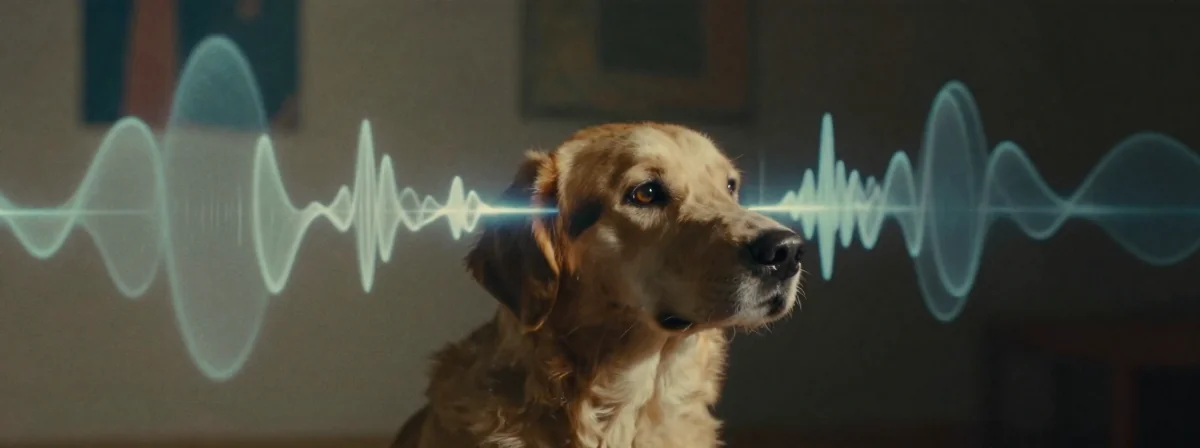
Ever feel like your dog’s ears are tuned to a secret radio station? They perk up at the faintest rustle, then suddenly flatten when the vacuum starts. It’s not just that they hear more noise—it’s that they hear a completely different kind of noise. The truth is, your dog’s world is filled with sounds you can’t even imagine, and it’s time we stopped thinking of their hearing as simply “better”—it’s fundamentally other. Here’s what’s really going on when your dog tilts their head.
The Frequency Secret
Dogs don’t hear louder, they hear more pitches.
Your dog isn’t cringing because the TV is blasting—they’re picking up high-frequency hums from the electronics, the buzz of fluorescent lights, or the ultrasonic whine of the remote. Humans hear roughly 20Hz to 20,000Hz, but dogs? Their range stretches to 45,000Hz. That means they’re detecting sounds you’d never even register—like the mosquito whine you barely notice or the high-pitched whine of a smoke detector battery. It’s not about volume; it’s about the symphony of sounds you’re deaf to.Their ears are like a finely tuned radar.
Ever see your dog’s ears swivel toward a distant siren? That’s because they can detect quieter sounds at greater distances. While you might hear a car approaching, your dog could hear the engine’s high-frequency vibration from blocks away. It’s not that the sound is louder for them—it’s that their ears are designed to capture the subtle details you miss. Think of it like having a microscope for your ears.
The Volume Myth
- Loudness isn’t the issue—frequency is.

You might crank the music and think your dog’s ears are bleeding, but they’re actually fine with the volume. What bothers them are the high-pitched frequencies in your music, the TV’s electronic hum, or even the ultrasonic sounds from pest repellents. It’s not that the TV is too loud—it’s that the 15kHz whine coming from the speakers is like a jackhammer to their ears. Ever wonder why they bolt when the smoke alarm chirps? That 3kHz chirp is piercing to them, even if it’s just a faint buzz to you.
- Volume doesn’t work the same way for them.
If you blast action movies, yes, that’s too loud for anyone. But normal TV volume? They adapt to it, just like you adapt to background noise. The real difference is that their ears are filtering in sounds you’ve tuned out. It’s like wearing noise-canceling headphones—except their ears are canceling your sounds to focus on theirs. They’re not overwhelmed by loudness; they’re overwhelmed by the sheer amount of sound.
The Human Hearing Hack
We’ve got our own secret weapon.
While dogs hear a wider range, humans have a trick of our own: our brains amplify the frequencies of human speech. That’s why you can tune out a crowd but still hear your name called across a noisy room. For dogs, their brains amplify frequencies that help them track prey or detect danger. So while you’re hearing the TV’s dialogue clearly, your dog is hearing the high-pitched electronic buzz that comes with it. It’s not a battle of who hears better—it’s a collaboration of different sensory worlds.It’s not about brightness, it’s about clarity.
Remember the last time you got your ears cleaned? Suddenly, everything sounded so crisp. That’s what dogs experience every day. They don’t hear the world louder; they hear it clearer. High frequencies that would be muffled to you are crystal clear to them. It’s like the difference between a standard-definition TV and a 4K screen—not just sharper, but revealing details you never knew were there.
The Silent Sounds That Hurt
Some sounds are invisible to us but unbearable to them.
Think about the ultrasonic devices that repel pests. To you, they’re silent. To your dog, it’s like a never-ending air horn. Or consider the high-pitched whine of a cheap fluorescent light—annoying to you, torture to them. These silent sounds are constant stressors in their environment, and we barely even notice. It’s like living with a migraine that only you can’t feel.Their world is layered with sounds we’ll never touch.
Dogs hear the ultrasonic squeaks of rodents, the high-pitched calls of birds, and the subtle rustles of insects. They’re tuned into a frequency range that’s invisible to us, and that’s why their hearing seems so supernatural. It’s not magic—it’s biology. And while we can’t step into their world, recognizing it changes how we see them. They’re not just pets; they’re beings living in a dimension of sound we can only imagine.
The Final Frequency
Dogs aren’t just hearing what we hear—they’re hearing what we can’t. The next time your dog’s ears perk up at something you can’t hear, remember: they’re not just listening; they’re living in a world of sound that’s entirely their own. And maybe, just maybe, we’re the ones missing out.