
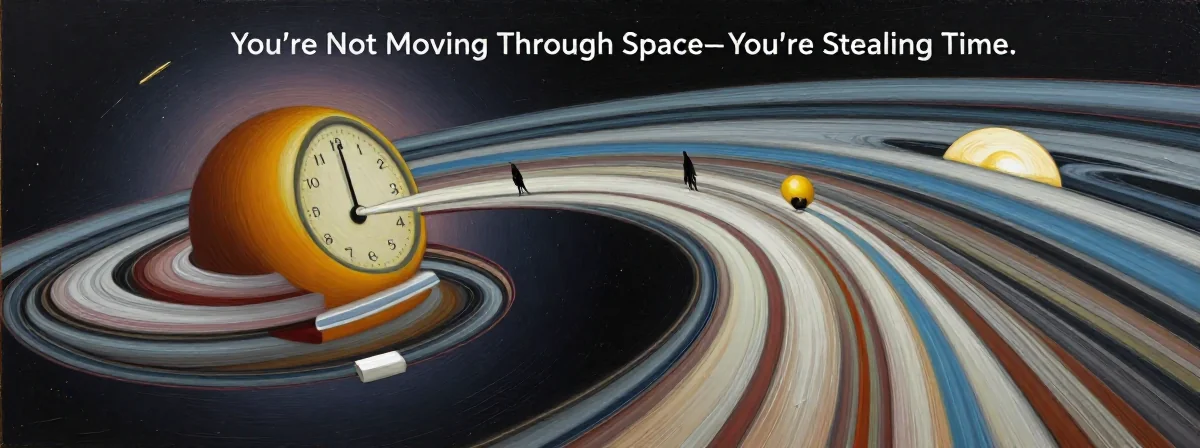
Some nights, I stare at the stars and wonder: why do they look like they did years ago? The answer is both terrifying and beautiful. It’s not that the stars are slow—it’s that time itself bends when you push the universe’s speed limit. Let’s talk about what happens when you start moving fast enough to notice.
The Teaching
A light year isn’t time, it’s distance—6 trillion miles of it. Think of it like this: if you could drive at the speed of light, a light year is how far you’d go in a year. But since light itself is moving at 186,000 miles per second, that distance adds up fast. When we say a star is 4 light years away, we mean what you see is how it looked 4 years ago. You’re literally looking at the past—because light can’t teleport, it has to travel. That delay isn’t an error, it’s the universe’s way of showing us history in real time.
Time slows down when you speed up—but only if you’re going near light speed. Pilots and even astronauts don’t notice it because we’re still crawling at fractions of light speed. But if you could hit 96.8% of light speed, time would stretch like taffy. A 20-year journey for Earth would feel like 5 years to you. The weird part? To you, Earth’s time would seem to speed up. It’s not that time itself is breaking—just that your perspective of it changes when you break physics’ speed limit.
You’re always moving at light speed—just not all in space. This is the mind-bender: everything in the universe moves at exactly light speed through spacetime. When you’re standing still, all that movement is through time. The moment you start moving through space, you’re “stealing” from your time budget. It’s like a pool of energy—you can spend it moving through space or through time, but not both at full speed. Drive at 50 mph? You’re moving through time at “only” 90% of normal speed. This isn’t just theory—it’s why GPS satellites have to correct for time dilation or your maps would be off miles every day.
- The faster you go, the more the universe bends around you. Imagine throwing a ball on a train. To you, it moves at 10 mph. To someone on the ground, it moves at train speed + ball speed. But light doesn’t play by those rules. Shine a flashlight forward on that train, and both you and the observer see the light moving at exactly light speed. The only way that’s possible is if time itself warps for the train. That’s why, if you could watch Earth from your near-light-speed rocket, you’d see people aging like fast-forwarded footage—while your own clock ticks normally. It’s not an illusion; it’s the universe enforcing its one true speed limit.
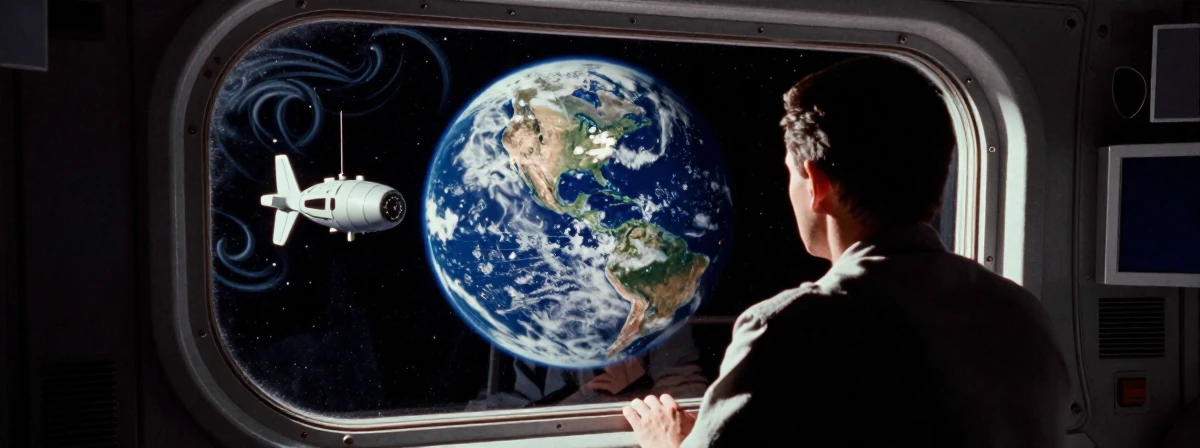
- Photons don’t experience time at all. Light itself is outside the time dimension. A photon emitted from a star a billion years ago doesn’t “age” during its journey. To it, the moment it was created and the moment it hits your eye are simultaneous. That’s why distant stars look frozen in time. The universe isn’t delaying the light—it’s that light exists outside the flow of time altogether. The next time you see a star, remember: you’re witnessing a moment that, for the light itself, never passed.
Parting Wisdom
We spend our lives thinking time is a steady river, but it’s more like a riverbed that shifts when you push too hard against its flow. The next time you feel rushed, remember: speed isn’t just about covering distance—it’s about deciding what dimension you want to move through. When you sprint through space, you’re not just leaving places behind—you’re leaving time behind too. The universe will always keep its speed limit, but it won’t stop you from trading your future for a faster journey.