
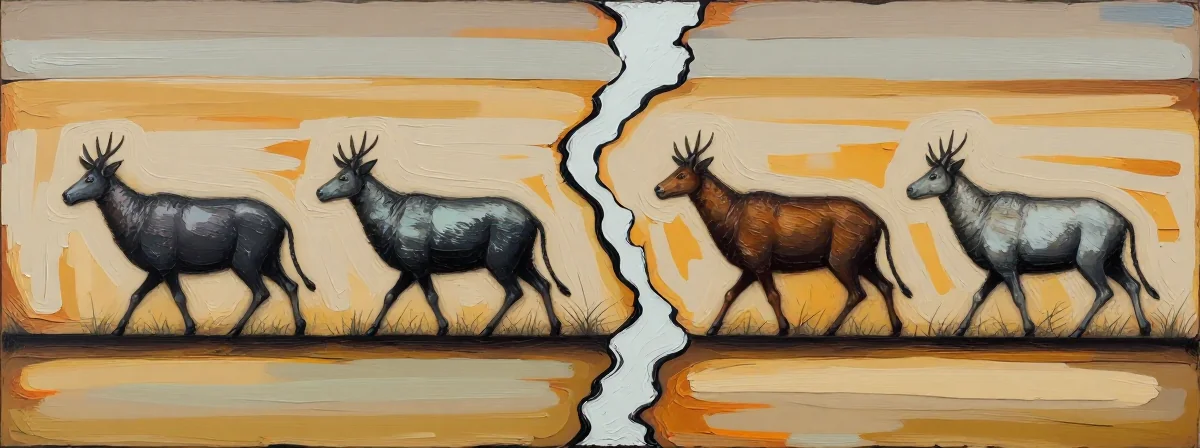
Have you ever looked at a simple chicken cutlet and wondered if it could speak? Or considered how some people love cilantro while others find it tastes like soap? These seemingly random preferences actually reveal something profound about how species evolve. The boundaries between species aren’t always clear-cut walls; sometimes they’re subtle shifts in preference that gradually build barriers over generations.
The concept of evolution often feels abstract—something that happened millions of years ago, captured only in fossils. But the reality is far more immediate and observable. Evolution isn’t just history; it’s happening right now, in ways we can witness directly if we know where to look. From your garden to distant ecosystems, real-time evolutionary changes are occurring that challenge our understanding of how quickly life can adapt and diverge.
A biologist who spent a year working with immortal cell lines isolated from Fall Armyworm moths once described the experience as “getting to observe speciation in real time.” This isn’t just academic jargon; it’s a window into processes that shape our world in ways most of us never consider.
What Makes Moths Choose Crayons Over Cereal?
The discussion about moths that prefer to eat crayons and Lucky Charms touches on something fascinating: food preference as a driver of evolutionary divergence. It’s not just a quirky fact; it’s a fundamental mechanism of speciation. When populations develop different dietary preferences, they not only change what they eat but also where they live, when they’re active, and ultimately, who they mate with.
Consider the Fall Armyworm (Spodoptera frugiperda), a species that has actually split into two distinct strains based entirely on food preference. One strain feeds on corn, while the other prefers rice and sorghum. This isn’t just a matter of taste; these preferences have led to genetic differences that prevent them from successfully interbreeding in the wild. The strains have developed different pheromones, different mating times, and even different enzyme systems to digest their preferred foods.
What’s particularly striking is how quickly this divergence occurred. Agricultural practices that created distinct food sources for these moths only date back about 80 years—barely a blink in evolutionary terms. Yet we’re already seeing clear genetic and behavioral differences that could eventually lead to full speciation.
Why Do Geese Need Different Migration Routes?
Canadian geese provide another stunning example of evolution in action. Certain populations have begun following much smaller migration loops, spending more time nesting between trips. Over time, they’ve stopped breeding with geese who follow the traditional longer routes. The geese in this subgroup have already started to become larger than average—a clear physical divergence driven by behavioral changes.
This isn’t just an interesting biological factoid; it’s a preview of how new species form. The geese aren’t consciously deciding to evolve differently; they’re simply responding to environmental pressures in slightly different ways. Those that stay longer in nesting areas may have better access to food resources, leading to better survival and reproductive success. Over generations, these small advantages accumulate into noticeable differences.
Imagine in 200 years we might have the Giant Mid-Atlantic Goose as a separate species taxonomically. This isn’t science fiction; it’s a plausible outcome based on observable trends. The process is slow enough that we don’t notice it day to day, but fast enough that we can track it over human lifespans.
How Do Insects Become Biological Factories?
The conversation about baculoviruses turning moths into “amazing factories for recombinant protein” reveals a fascinating intersection of evolution and biotechnology. Certain moth cell lines (like SF21 and SF9) have been engineered to produce proteins for medical applications, including COVID-19 antigens for vaccines.
What makes this relevant to evolution is how these cell lines were selected and maintained. The fact that they’re “immortal” isn’t natural; it’s the result of laboratory selection for cells that can divide indefinitely. This process mirrors natural selection in how it favors certain traits—only in this case, the selection pressure comes from laboratory conditions rather than natural ecosystems.
These engineered systems highlight something crucial about evolution: it’s about adaptation to specific conditions. Whether those conditions are natural or human-created, organisms will evolve to thrive in their particular environment. The same principles that allow moths to develop crayon-eating preferences also allow scientists to create protein-producing cell lines.
What Makes Some Insects Terrorize Gardens?
The frustration with Armyworms that “are trying to kill my garden” illustrates a common human-insect conflict that has evolutionary implications. When gardeners respond by using BT (Bacillus thuringiensis) to control these pests, they create selection pressure that favors resistant individuals.
This isn’t just a gardening problem; it’s a microcosm of evolutionary arms races that occur throughout nature. Pesticide resistance evolves rapidly because the selection pressure is intense—only individuals with resistance genes survive to reproduce. Over time, entire populations can shift to become resistant, requiring stronger or different control methods.
The solution isn’t simply to use more pesticide; that only accelerates the evolutionary arms race. Instead, integrated pest management approaches that reduce reliance on chemical controls can slow resistance evolution. This practical application of evolutionary principles has real-world consequences for food security and environmental health.
Why Does “Gravy” Matter in Evolutionary Terms?
The passionate defense of “Sunday Gravy” versus “sauce” and proper pizza etiquette might seem like trivial cultural distinctions, but they actually mirror the mechanisms of speciation. When groups develop strong preferences for specific practices or traditions, they create social barriers that can lead to divergence over time.
Consider how food preferences can drive evolutionary change. Just as humans might develop distinct culinary traditions that reinforce group identity, animal populations can develop food preferences that lead to reproductive isolation. The intensity with which people defend their preferred pizza style or gravy terminology shows how strongly preferences can be held—and how these preferences can create boundaries between groups.
This isn’t just an analogy; it’s a real mechanism of evolutionary divergence. When populations specialize on different resources, they not only change their physical characteristics but also their behaviors, creating multiple barriers to interbreeding. The “burger people” versus “non-burger people” joke touches on this same principle—preferences that seem trivial can have significant evolutionary consequences over time.
Could We Actually Observe Human Speciation?
The thought experiment about humans evolving into “burger people” highlights how difficult it is to imagine speciation happening in our own species. Yet the mechanisms are the same. If human populations developed sufficiently different preferences, behaviors, or physical traits that prevented them from interbreeding, speciation could theoretically occur.
The Canadian geese example shows how relatively quickly this could happen—within a few hundred years. While human cultural evolution moves much faster than genetic evolution, the principles are similar. Strong cultural boundaries can create reproductive isolation even when physical barriers don’t exist.
What makes human speciation unlikely in practice is our mobility and cultural exchange. Unlike geese or moths that are constrained by geography or food sources, humans can overcome many natural barriers. But the underlying evolutionary principles remain the same—when populations develop differences that affect who they mate with, the stage is set for eventual speciation.
What Does Real-Time Evolution Teach Us About Life?
The most important insight from observing real-time evolution isn’t just that it happens—it’s how quickly and dramatically it can occur. The examples of moths, geese, and other organisms show that evolutionary change isn’t always a slow, gradual process spanning millions of years.
When we look at the Fall Armyworm’s split into corn-eating and rice-eating strains, or the Canadian geese developing different migration patterns, we see evolution as an active, ongoing process. These changes aren’t random; they’re responses to environmental pressures that we can often observe and even influence.
This perspective shifts how we view biodiversity and conservation. If species can form relatively quickly in response to environmental changes, then conservation efforts need to consider not just protecting existing species but also maintaining the conditions that allow for evolutionary adaptation. The gardeners battling Armyworms, the biologists studying cell lines, and the birdwatchers tracking geese are all, in their own ways, observing evolution in action.
The next time you enjoy a meal, consider the evolutionary journey that brought it to your plate. From the preferences that shaped agricultural crops to the adaptations that allow certain insects to thrive on unusual foods, evolution is woven into every aspect of our lives. Recognizing this connection transforms how we see the world—not as a static collection of species, but as a dynamic system of ongoing adaptation and change.