
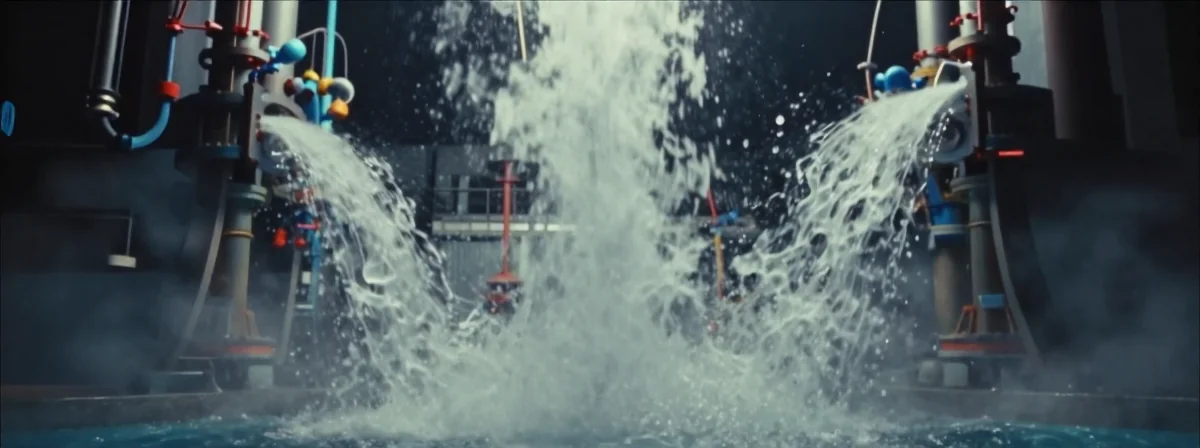
Ever wonder why every major power plant on the planet relies on water, even when we have access to exotic chemicals and advanced materials? It’s not just because it’s cheap and abundant. Water holds engineering secrets that make it the ultimate energy carrier, and understanding these can transform how you think about energy systems. The truth is, water’s unique properties create advantages that no alternative can match, from nuclear reactors to your car’s engine.
Water isn’t just a simple molecule; it’s a natural supermaterial with properties that were essentially designed by evolution to support life—and now support our energy needs. When you see those massive cooling towers or hear about steam turbines, you’re witnessing water doing what few substances can: carrying immense energy while remaining safe, accessible, and incredibly efficient. The real magic isn’t just in water itself, but in how it behaves under pressure and temperature changes—behaviors that engineers have harnessed for centuries.
The expansion ratio when water turns to steam is about 1700:1. That’s not a typo. Imagine a gallon of water suddenly expanding to fill a small swimming pool. This incredible expansion is what drives turbines, creates pressure differentials, and makes water the workhorse of our energy systems. And unlike many alternatives, water doesn’t require special handling, isn’t toxic, and doesn’t need expensive containment systems. These aren’t minor advantages—they’re fundamental game-changers in energy production.
Why Lower Boiling Points Actually Hurt Efficiency
It might seem logical that a substance with a lower boiling point would be more efficient, right? After all, it would require less energy to turn into steam. But here’s the counterintuitive truth: engines actually become less efficient when using fluids with lower boiling points. The Carnot cycle efficiency principle shows that the greater the temperature differential between the heat source and the cooling medium, the more work can be extracted from the system. Water’s relatively high boiling point (at standard pressure) allows for these larger temperature differentials.
Consider this: nuclear reactors operate at pressures exceeding 2200 PSI (15.5 MPa) precisely to raise water’s boiling point. The Iowa Class battleship’s steam system ran at 600 PSI (4 MPa) and 850°F (450°C). These extreme conditions aren’t arbitrary—they’re carefully calculated to maximize the temperature differential that drives efficiency. When you use a fluid with a lower boiling point, you’re actually limiting the temperature differential, which directly reduces the potential work output. It’s like trying to generate electricity with a tiny temperature difference—you just won’t get much power.
Modern car engines illustrate this perfectly. Decades ago, thermostats opened around 185°F, maintaining engine temperatures in the 190-195°F range. Today’s engines routinely operate at 225-230°F. This higher operating temperature creates a greater temperature differential between the engine and ambient air, allowing for more energy extraction from fuel before it exits through the exhaust or radiator. Water’s ability to handle these higher temperatures without becoming unstable is another key advantage that alternatives struggle to match.
The Pressure Is Where the Real Work Gets Done
We often think of steam as the magical force that powers turbines, but it’s actually pressure that does the heavy lifting. When water turns to steam in a sealed vessel, the pressure increase is what creates the force needed to spin turbines or move pistons. This is why high-pressure steam systems are the backbone of power generation—from nuclear reactors to industrial applications. The pressure physically pushes against turbine blades, converting thermal energy into mechanical energy.
The expansion of water to steam is what initially creates this pressure. Even in high-pressure systems like pressurized water reactors (PWRs), where water operates at 15.5 MPa, the fundamental principle remains the same. Water is pumped to high pressure, then heated at constant pressure to produce steam. This flowing system design leverages water’s unique properties: it’s dense enough to be pumped effectively, expands dramatically when heated, and remains stable under extreme conditions. Alternative fluids often can’t handle this combination of requirements.
Superheated steam represents another water advantage. By heating steam beyond its saturation temperature (which requires significant pressure), you can extract energy without the steam condensing back into water. Water droplets in turbines are extremely destructive, so maintaining steam phase is crucial. This ability to carry enormous energy without phase change is rare among potential working fluids, making water exceptionally valuable for power generation.
Beyond Energy: The Safety and Environmental Advantages
When evaluating energy systems, we often focus solely on efficiency metrics, but safety and environmental impact are equally critical considerations. Water excels in these areas in ways that alternatives cannot. A 10,000-gallon water leak into the environment is virtually harmless, whereas a similar leak of alternative coolants could be catastrophic. This safety profile allows water-based systems to be located closer to population centers and industrial sites without the same level of risk.
Water’s chemical stability is another often-overlooked advantage. While some metals can be affected by water over time, this is manageable with standard additives like hydrazine for oxygen elimination and ammonia for pH control. The water used in these systems is already demineralized, reducing corrosiveness. Most alternative fluids either require exotic, expensive containment materials or are inherently corrosive, toxic, or unstable. The environmental friendliness of water allows power plants to discharge cooling water into natural bodies without creating hazardous conditions.
Consider the contrast: if a power plant using alternative coolants were to experience a major leak, the environmental damage could last for decades. Water-based systems can safely release water back into natural systems, sometimes even creating habitats in cooling canals. This dual functionality—power generation and ecosystem support—is unique to water-based systems. The environmental footprint of water-based energy systems is fundamentally different from any alternative, offering a sustainable approach that aligns with growing environmental concerns.
The Economic Case: Why Water Always Wins
Even if alternative fluids could match water’s technical advantages, the economic case for water remains unbeatable. Water infrastructure already exists globally—pipelines, purification systems, and distribution networks are in place. The cost of water is effectively zero at scale, as it’s continuously recycled within power plants. Alternative fluids would require entirely new infrastructure, specialized handling, and constant replenishment, dramatically increasing operational costs.
The expansion ratio of water to steam (1700:1) creates another economic advantage. This massive expansion means water can do the work of much larger volumes of alternative fluids. Few substances can match this capacity, meaning alternative systems would require larger, more expensive equipment to produce equivalent power. When you factor in the complete lifecycle costs—including acquisition, handling, containment, and disposal—water’s economic advantages become even more pronounced.
Water’s ability to serve multiple functions in energy systems further enhances its economic profile. In nuclear reactors, water not only transfers heat but also acts as a moderator, adjusting power based on steam load. This dual functionality reduces the complexity and cost of the overall system. Alternative fluids typically serve only one purpose, requiring additional systems and controls to achieve the same results. The integrated nature of water-based systems creates efficiencies that are difficult to replicate with alternatives.
What This Means for Future Energy Systems
Understanding water’s unique advantages isn’t just an academic exercise—it has practical implications for how we design and implement energy systems today and in the future. While research continues into alternatives like liquid CO2, none have yet matched water’s combination of efficiency, safety, economic viability, and environmental friendliness. The engineering challenges of creating a viable alternative are immense, which is why water remains the standard after decades of innovation.
The properties that make water exceptional aren’t random—they’re the result of billions of years of natural selection. Water’s molecular structure gives it unique thermal properties, expansion characteristics, and stability that synthetic alternatives struggle to replicate. This natural optimization means that even with our advanced materials science, we haven’t created anything better than what nature already provides. The quest for alternative energy carriers continues, but water remains the benchmark against which all others are measured.
As we face growing energy demands and environmental concerns, the value of water in our energy systems will only increase. Rather than seeking to replace water, future innovations will likely focus on improving how we use water more efficiently and sustainably. From advanced recycling systems to better containment technologies, the next generation of energy systems will build upon water’s advantages rather than attempting to circumvent them. The ultimate energy carrier wasn’t created in a lab—it was created by nature, and we’re just beginning to fully appreciate its potential.